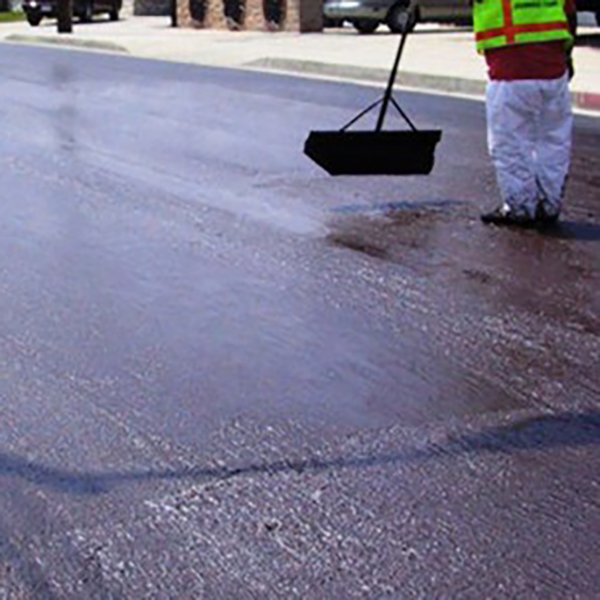


Viscosity Grade Bitumen

Viscosity Grade Bitumen (VG Bitumen) represents a contemporary classification system for paving bitumen, crafted to ensure reliable performance across a range of temperature and traffic conditions. Unlike the conventional penetration grading method, VG Bitumen is classified according to its viscosity, or flow resistance, measured at standardized temperatures. This approach guarantees consistent performance during mixing, laying, compaction, and throughout its service life. This innovative grading system enhances durability, temperature resistance, and overall pavement quality, making it effective in both hot and cold climates.

فئات

Viscosity Grade Bitumen (VG Bitumen) represents a modern approach to classifying paving bitumen, tailored to deliver reliable performance across varying temperature and traffic conditions. Unlike the traditional Penetration Grade system, which assesses hardness through penetration depth, the VG classification is based on viscosity, or resistance to flow, measured at standardized temperatures. This ensures bitumen behaves predictably under extreme temperatures during both construction and its service life.

According to IS 73:2013 and ASTM D2171, VG Bitumen is divided into four grades:

 VG-10, VG-20, VG-30, and VG-40. Each grade corresponds to specific viscosity ranges that determine its suitability for diverse applications, from colder climates to highways experiencing heavy traffic and high temperatures.

 VG-10: Best suited for colder regions or high-altitude areas where faster workability is crucial. VG-20: Appropriate for moderate climatic and traffic conditions.

 VG-30: The most commonly utilized grade for highways, offering an optimal compromise between stiffness and flexibility.

VG-40: Designed for tropical regions and roads with heavy traffic loads, ensuring enhanced durability and resistance to rutting.

The VG grading system provides engineers with precise control over bitumen selection, resulting in superior pavement quality, minimized rutting, and improved thermal stability. This methodology has gained widespread acceptance in regions like India, the Middle East, and Africa, where temperature fluctuations heavily influence asphalt performance.

Key Benefits

Viscosity Grade (VG) Bitumen offers an extensive array of advantages that place it ahead of  traditional penetration-based systems in performance and reliability.

1. Predictable Performance: VG bitumen delivers consistent performance across a wide range of temperatures, maintaining its strength and elasticity in both frigid mountainous areas and hot tropical climates. Its viscosity-based classification allows engineers to select the precise grade needed for specific environmental and mechanical requirements.

2. Enhanced Durability: Higher grades, such as VG-30 and VG-40, exhibit excellent resistance to deformation under heavy traffic loads, effectively reducing rutting and surface wear. Furthermore, their stable composition enhances resistance to oxidation and aging—key factors in prolonging pavement life and minimizing deterioration over time.

3. Superior Adhesion and Workability: VG bitumen forms robust bonds with aggregates, leading to improved compaction and fewer air voids. This ensures better load distribution, smoother surface finishes, and decreased permeability. Additionally, its rheological properties enable easier mixing and uniform coating at lower temperatures, contributing to reduced energy consumption during production.

4. Economic and Environmental Benefits: By requiring lower heating temperatures during mixing and application, VG bitumen can save up to 10–15% on fuel costs. The reduced emissions during production make it a greener choice for environmentally conscious construction. Its durability extends the life of road surfaces, further lowering maintenance expenses and increasing cost efficiency in the long run.

5. Improved Design Precision and Safety: The VG grading system allows engineers to accurately predict pavement behavior, minimizing the risk of failures due to inappropriate binder selection. With a higher flash point (exceeding 220°C), VG bitumen offers added safety during storage, transportation, and handling, reducing risks in asphalt production processes.

6. Application Versatility: From highways and airstrips to bridge decks, urban streets, and industrial zones, VG bitumen adapts effortlessly to various construction scenarios. It works exceptionally well with both hot-mix and warm-mix asphalt technologies, making it suitable for modern paving applications.

Technical Specification

Viscosity Grade Description Typical Application Performance Characteristics
VG-10 Lowest viscosity, easy to pump and mix Cold and low-temperature regions Softening point ~40°C, high safety flash point (>220°C)
VG-20 Moderate hardness and workability Mild climatic conditions Balanced stiffness, high solubility (>99%)
VG-30 Optimal balance between stiffness and workability Heavily trafficked highways Excellent resistance to deformation
VG-40 Highest viscosity and maximum stiffness Extreme temperatures and heavy axle loads Softening point >50°C, superior durability

Packaging

VG Bitumen is available in a range of packaging options tailored to cater to both domestic construction needs and international export requirements.

1. Steel Drums This is the most widely used packaging format, featuring new steel drums with a capacity of 180–200 kg. These drums are internally lacquered to prevent chemical reactions and are tightly sealed to protect the contents from air and moisture. Ideal for smaller-scale construction projects and containerized exports, they ensure safe transport while minimizing contamination.

2. Bulk Shipments For large-scale infrastructure developments or refinery needs, bitumen is transported in heated bulk tankers or bitutainers, preserving its stability and viscosity over long distances. This method streamlines operations by eliminating the need for repackaging, enabling faster and cleaner unloading while cutting down on handling costs.

3. Jumbo Bags and Poly Bags In specific markets, VG bitumen is also made available in 1 MT jumbo bags or durable polyethylene bags that can endure temperatures exceeding 100°C. These innovative packaging solutions facilitate easier storage, minimize drum waste, and support sustainability efforts in extensive road construction projects.

4. Storage and Handling Recommendations VG bitumen should be stored in a cool, dry, shaded environment, away from direct sunlight and open flames. Gradual heating, up to a maximum of 160°C, is recommended to maintain the desired viscosity and prevent polymer degradation. Storage tanks should feature temperature control systems and adequate ventilation to avoid oxidation.

Standards and Certifications

Category Details
Applicable Standards IS 73:2013, ASTM D2171, AASHTO T201, ASTM D36 (Softening Point)
Quality Control Tests Viscosity, Penetration, Flash Point, Ductility, Solubility
Certifications ISO 9001 (Quality Management), ISO 14001 (Environmental Management), ISO 45001 (Occupational Health & Safety)
Third-Party Inspection SGS, Bureau Veritas
Export Compliance Conforms to local and international project specifications
Application Asphalt paving and industrial applications

Quality Contorol

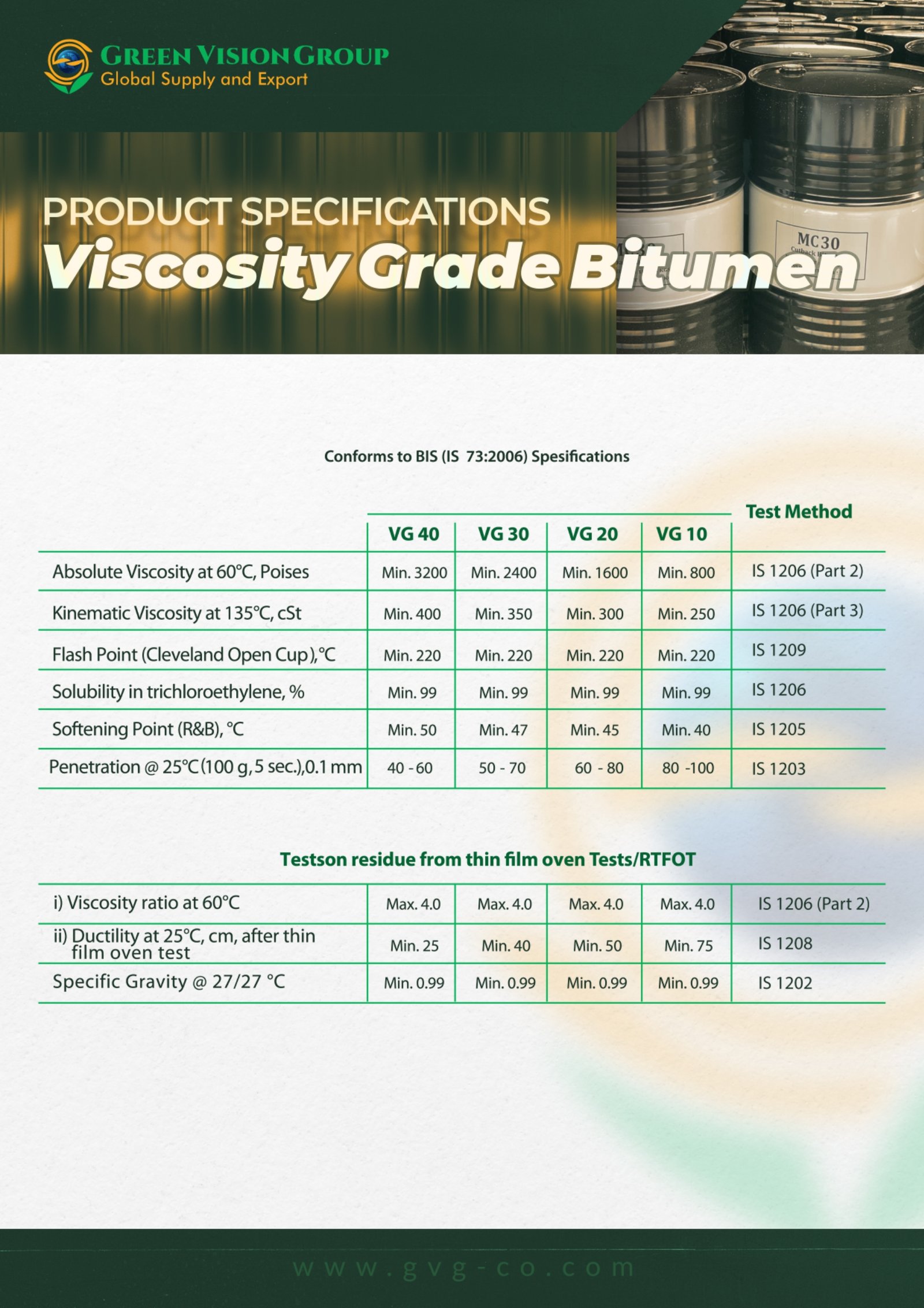
Viscosity grade bitumen (VG) laboratory analysis table